签派放行
定义
1.污染跑道、湿跑道、湿滑跑道、干跑道
以下AC121未经说明为CCAR AC-121 航空承运人湿跑道和污染跑道运行管理规定(有效)。
污染跑道:
AC121定义
污染跑道:跑道正在或计划使用的长度和宽度范围内的表面区域,有很大一部分(不管是否为孤立区域)都覆盖有压实的雪、干雪、湿雪、雪浆、霜、冰和积水等一种或多种污染物。
CCAR121定义
污染跑道:飞机起降需用距离的表面可用部分的长和宽内超过 25%的面积(单块或多块区域之和)被超过3毫米(0.118英寸)深的积水,或者被当量厚度超过3毫米(0.118英寸)水深的融雪、湿雪、干雪,或者压紧的雪和冰(包括湿冰)等污染物污的跑道。如果跑道的重要区域,包括起飞滑跑的高速段或起飞抬轮和离地段的跑道表面被上述污染物覆盖,也应该算作污染跑道。
湿跑道:
AC121定义
湿跑道:跑道正在或计划使用的长度和宽度范围内的表面区域内,覆盖有任何明显的湿气或不超过3毫米深的水。
CCAR121定义
湿跑道:当跑道表面覆盖有厚度等于或小于3毫米(0.118英寸)的水,或者当量厚度等于或小于3毫米(0.118英寸)深的融雪、湿雪、干雪;或者跑道表面有湿气但并没有积水时,这样的跑道被视为湿跑道。
湿滑跑道:
AC121定义
湿滑跑道:湿跑道,而且其相当一部分的跑道表面摩阻特性确定为已经降级。
干跑道:
AC121定义
干跑道:跑道正在或计划使用的长度和宽度范围内的表面区域内,其表面无可见湿气且未被压实的雪、干雪、湿雪、雪浆、霜、冰和积水等污染物污染。
CCAR121定义
干跑道:飞机起降需用距离和宽度范围内的表面上没有污染物或可见的潮湿条件的跑道。对于经过铺筑、带沟槽或具有多孔摩擦材料处理,即使在有湿气时也能保持“有效干”的刹车效应的跑道也算干跑道。
Tips:如上面所写,对于 污染跑道、湿跑道、干跑道 的定义,CCAR121R7和AC121存在出入,CCAR121R7为有效的民航规章,而AC121为有效的规范性文件,于情于理应该以CCAR121R7为准?
但结果真的应该这样吗?答案是否定的。
1.CCAR121R7于2021年3月份发布,而《航空承运人湿跑道和污染跑道运行管理规定(有效)》于2021年11月份发布,所以说AC121应该是更具有时效性的文件。
2.其次我们可以在CAAC官网上看到旧版的咨询通告:CCAR AC-121-FS-2009-33 《航空承运人湿跑道和污染跑道运行管理规定(失效)》,其定义与CCAR121 R7定义相同。但是在新版的CCAR AC-121-FS-33R1 航空承运人湿跑道和污染跑道运行管理规定(有效)生效后,旧版的定义即现在CCAR121R7 的定义已经失效了。
综上,应当以我们AC121的定义为准。
2.刹车效应
刹车效应:飞行员用来描述与飞机机轮刹车力和方向可控性有关的减速术语。
3.跑道状况报告(RCR)
跑道状况报告(RCR):一套与跑道表面状况及其对航空器着陆和起飞性能所产生影响相关的综合标准化报告。
4.跑道状况评估矩阵(RCAM)
跑道状况评估矩阵(RCAM):根据跑道表面状况及飞行机组提供的制动报告(刹车效应报告),按相关程序能对跑道状况代码进行评估的矩阵。
5.跑道状况代码(RWYCC)
跑道状况代码(RWYCC):用来描述跑道表面状况的数字,可以直接表示道面状况对航空器滑跑性能(主要指着陆滑跑性能)的影响。
6 – 干跑道。
5 – 轮胎上施加的制动力所达到的减速效果正常,并且能正常控制方向。
4 – 制动减速或方向控制能力在好与中之间。
3 – 轮胎上施加的制动力所达到减速效果明显降低或方向控制能力明显降低。
2 – 制动减速或方向控制能力在中与差之间。
1 – 轮胎上施加的制动力所达到的减速效果大幅度降低或方向控制困难。
0 – 轮胎上施加的制动力所达到的减速效果几乎为零或无法控制方向。
6.跑道表面状况(RSC)
跑道状况报告中关于跑道表面状况的一种说明,可作为确定跑道状况代码、计算飞机性能的依据。
a)干跑道
b)湿跑道
c)湿滑跑道
d)污染跑道
e)跑道表面状况描述词。跑道表面上的下列要素之一:
i)压实的雪(COMPACTED SNOW):已被压成固态状的雪,使得航空器轮胎碾压后不会进一步大幅压实表面或在表面形成凹痕。
ii)干雪(DRY SNOW):不容易形成雪球的雪。
iii)霜(FROST):霜由温度低于冰点的表面上的空中潮气所形成的冰晶构成。霜与冰的不同点在于,霜晶单独增长,因此粒状构造特征更为明显。
iv)冰(ICE):已结成冰的水或在寒冷且干燥条件下已转变成冰的压实的雪。
v)雪浆(SLUSH):水分饱和度非常高,使得用手捧起时,水将从中流出,或者用力踩踏时会溅开的雪。
vi)积水(STANDING WATER):从飞机性能角度考虑,位于使用之中的所需长度和宽度范围内的跑道表面区域(不管是否为孤立区域)的25%以上覆盖有超出3毫米深的水。
vii)湿冰(WET ICE):表面有水的冰或者正在融化的冰。
viii)湿雪(WET SNOW):所含水分足以能够滚出一个压得很实的实心雪球但却挤不出水分的雪。
ix)润湿(DAMP):表面由于湿气而颜色有所改变。
x)潮湿(WET):表面已湿透但并无积水。
7.飞机地面减速设备
飞机地面减速设备:地面滑跑中用于滑跑减速或提高减速率的任何设备。这些设备可能包括但不局限于:刹车(人工刹车或自动刹车)、扰流板和反推。
CCAR AC-121-FS-33R1 航空承运人湿跑道和污染跑道运行管理规定(有效)对签派的要求
a)签派放行时应重点关注湿跑道或污染跑道的实况或预报,以及任何影响起飞和着陆距离的因素,严格放行标准。
b)放行要求
(1) 在湿跑道或污染跑道上起飞,航空公司应当使用修正的起飞重量或按相应条件计算的起飞重量,而且不得大于相同条件下干跑道的最大起飞重量。
(2) 在有关的气象报告、预报或两者组合表明目的地机场跑道在预计着陆时刻可能是湿的时,该目的地机场的有效跑道长度应当至少为CCAR-121 部 195 条(b)款所要求的跑道长度的115%,否则,该飞机不得起飞。如果在湿跑道上的实际着陆技术证明,对特定型号的飞机,已经批准了某一较短但不小于 195 条(b)款要求的着陆距离,并且已经载入飞机飞行手册,航空公司则可以按照手册的要求执行。
(3) 在有关的气象报告、预报或两者组合表明目的地机场跑道在预计着陆时刻可能是污染的时,该目的地机场的有效跑道长度应当至少为以下距离中的较大者:CCAR-121部195条(b)款 所要求的跑道长度的115% ,以及根据认可的 污染跑道着陆距离数据确定的着陆距离的115% 。(注:如果飞机制造商没有提供污染跑道上的着陆距离数据,可以使用表1来进行计算,表1已包含了15%的余量,不再乘以115%),否则,该飞机不得起飞。如果上述污染跑道的道面已经进行了特殊处理,而且实际着陆技术证明,对特定型号的飞机,已经批准了某一较短但不小于CCAR-121 部 195 条(b)款要求的着陆距离,并且已经载入飞机飞行手册,航空公司则可以按照手册的要求执行。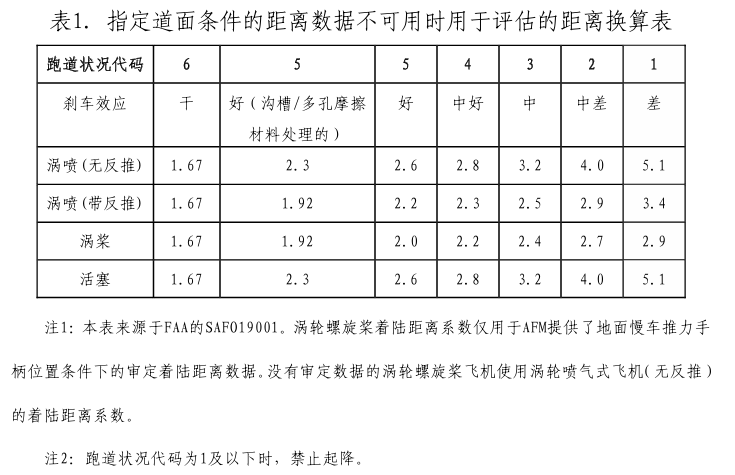
c)航空公司应当参照本通告相关要求制定签派员训练大纲并进行相应的训练和复训。
航行情报
雪情通告识读
飞机性能
定义
1.审定着陆距离:根据CCAR-25部第125条规定,按人工驾驶着陆、人工最大刹车,以入口速度(VREF)、50英尺(15米)高进跑道、水平干跑道、标准大气温度计算的从跑道入口到全停时所用的距离。审定着陆距离也称演示着陆距离(Demonstrated Landing Distance),它未包含任何安全余量,也不使用自动刹车、自动着陆系统、平视引导(HUD)系统或反推,审定着陆距离通常不等于运行着陆距离。
2.运行着陆距离(OLD):根据报告的气象和道面条件、标高、跑道坡度、飞机重量、飞机构型、进场速度、自动着陆系统或HUD系统的使用,以及预计着陆时将要使用的减速设备等条件所对应的着陆距离。该距离中不包括任何的安全余量,代表了飞机在此条件下的最佳性能。
3.所需着陆距离(RLD):在CCAR-25部中第125条所要求的审定着陆距离基础上,再加上适用的运行规章所定义的飞行前的计划安全余量所得到的着陆距离(例如,干跑道条件下,CCAR-121部第195条中关于涡轮发动机驱动的飞机放行所要求的所需着陆距离为审定着陆距离除以0.6)。
4.可用着陆距离(LDA):公布的跑道可用着陆距离。该距离可能会比跑道的总长度更短,例如跑道入口内移这种情况。
5.摩擦阻力:两个接触表面之间沿相对运动方向的阻力。
6.跑道表面摩阻特性:与跑道表面性质有关并能彼此区别的摩擦阻力的物理、功能和运行特性或属性。
7.放行前的着陆距离评估:基于CCAR-121 部第195 条的相关规定,考虑到飞行中正常的燃油和滑油消耗后飞机到达目的地时的着陆重量,根据飞机飞行手册中对该目的地机场的气压高度和预计在着陆时当地风的情况、道面状态所对应的着陆距离进行评估。
8.到达时的着陆距离评估:考虑到飞行机组的工作负荷,在尽可能接近目的地机场的地方,根据实际条件而不是签派放行时的预报条件来进行的着陆距离的评估。之所以选择接近目的地机场的地方是为了获得最接近实际着陆条件下的气象和道面条件信息,但该位置不得晚于仪表进近程序的起始点或目视进近起落航线的加入点。
CCAR AC-121-FS-33R1 航空承运人湿跑道和污染跑道运行管理规定(有效)对飞机性能分析的要求
a)在湿跑道或污染跑道上运行时,航空公司必须进行飞机性能修正或相应条件的计算,并且其数据便于机组查找和使用。
b)飞机性能修正或相应条件的计算应使用飞机性能软件或电子飞行包,或者利用飞机制造商推荐的方法。
c)在进行航线性能分析时,需要对干跑道、湿跑道和该机场可能预见的污染跑道进行着陆分析。如存在着陆限制(即:着陆重量小于结构限制最大着陆重量),航空公司应提供着陆性能数据。
飞行操作
1.到达时的着陆距离评估要求
航空公司应为飞行机组提供相关的程序,以便其根据到达时的实际条件而不是签派放行时的预报条件来进行着陆性能的评估。这些实际条件包括气象条件(机场气压高度、风向和风速等)、跑道状况报告、进场速度、飞机重量和构型以及将要使用的减速设备等。根据上述条件得到运行着陆距离后,应当再加上15%的安全余量,并且仍然不大于跑道的可用着陆距离。飞行机组使用上述相关程序进行了着陆距离的评估之后,如果不能保证至少15%的安全余量,不得进行着陆,紧急情况除外。
上述安全余量代表了到达时的预计运行着陆距离与可用着陆距离之间必须有的最小距离余量,而且考虑了相应的气象和道面条件、飞机构型和重量条件下以及预计要使用的飞机地面减速设备的影响。也就是说,将要使用的跑道的可用着陆距离必须能够保证飞机在实际条件下以着陆时的构型实现全停,并且仍然留有至少15%的安全余量。
航空公司可以采用多种方法来使运行简单化甚至免去评估,从程序上来说,应当采用最适合航空公司当前程序的方法。在运行手册系统中应当清晰地向有关人员说明相关程序。下列方法并没有包括所有方法,仅仅是符合性方法的一些范例:例:
(1) 基于可预见的最恶劣的气象和道面条件,针对航空公司的特定机型建立能够符合本通告的最短跑道长度要求。
(2) 放行前着陆距离计算中所考虑的相应条件/构型等相关信息,作为放行文件的一部分提供给飞行机组,以便飞行机组在到达时进行对照检查,决定是否需要进行着陆距离评估。
(3) 将基于相关参数能够得到着陆距离的图表数据提供给飞行机组和/或签派员,并体现在航空公司的运行程序中。
(4) 能够基于相关参数实现着陆距离计算的电子飞行包设备。
这项评估并不意味着每次着陆前必须进行一个特定的着陆距离计算。多数情况下,由于起飞前的计算准则已经计入了较大的安全余量,所以在到达时的着陆距离能够满足至少15%的安全余量要求。当在飞行中目的地机场的相关条件(例如:道面条件、将要使用的跑道、风等)、飞机的着陆重量/构型/速度/减速设备变差的情况下,或者起飞是基于CCAR-121 部 195(c)(e)款来实施的前提下,通常就需要采用计算或其他方法来确定运行着陆距离。航空公司应当建立相关程序来确定何时必须采用计算或其他方法来确定预计的运行着陆距离,以保证到达时至少有15%的安全余量。
航空公司可以要求飞行机组来执行这项评估,或者建立其他的程序来完成此项评估。不管航空公司建立了何种方法,其程序都应当考虑所有放行前的计算条件和到达时的实际情况。
大多数航司通过EFB中性能软件(FLYSMART)进行检查。
在可行的前提下,着陆距离的评估应当尽可能地在接近飞机到达时完成,并且利用当时最新的信息。考虑到飞行关键阶段的工作负荷,推荐的做法是收到自动终端情报服务(ATIS、D-ATIS)或落地条件后,在下降顶点前作进近简令时计算并进行着陆距离评估。着陆距离评估完成后,如果相关条件发生了变化,飞行机组需评估是否再次计算着陆距离,以确保着陆安全。
2.机组标准操作程序(SOP)要求
在湿跑道和污染跑道上安全运行,良好的机组标准操作程序(SOP)是降低风险的主要手段,除正常程序以外,还应关注以下风险:
(1) 在进近开始前,应当评估影响飞机在湿跑道和污染跑道上安全运行的相关因素,特别是不利的气象条件和到达时的着陆距离;
(2) 合理评估着陆区域及超出着陆区域接地时机组应采取的措施;
(3) 接地动作的有效性以保证扎实接地;
(4) 减速设备和前轮转弯手轮的使用。
3.飞行机组训练要求
要求航司有理论训练和实操训练。所有的模拟机训练中,应当包含不同气象条件下湿跑道和污染跑道起飞着陆训练。重点关注中断起飞、超出着陆区域接地机组应采取的措施、大侧风下着陆动作的练习。
4.重要阈值
(1) 当RWYCC为“0”或“1”时,禁止航空器起降。
(2) 当跑道表面有超过13毫米(含)深的积水或当量厚度的污染物时,禁止航空器起降。
(3) 当雪情通告中“H项 RWYCC对应的跑道宽度”小于45米时,禁止航空器起降。
(4) 在污染物跑道上起飞,不能使用灵活温度(假设温度)减推力起飞。
Q&A
各个类型干湿跑道跑道的定义应该以哪个规章为主?
对于 污染跑道、湿跑道、干跑道 的定义,CCAR121R7和AC121存在出入,CCAR121R7为有效的民航规章,而AC121为有效的规范性文件,于情于理应该以CCAR121R7为准?
但结果真的应该这样吗?答案是否定的。
1.CCAR121R7于2021年3月份发布,而《航空承运人湿跑道和污染跑道运行管理规定(有效)》于2021年11月份发布,所以说AC121应该是更具有时效性的文件。
2.其次我们可以在CAAC官网上看到旧版的咨询通告:CCAR AC-121-FS-2009-33 《航空承运人湿跑道和污染跑道运行管理规定(失效)》,其定义与CCAR121 R7定义相同。但是在新版的CCAR AC-121-FS-33R1 《航空承运人湿跑道和污染跑道运行管理规定(有效)》生效后,旧版的定义即现在CCAR121R7 的定义已经失效了。
综上,应当以我们AC121的定义为准。
当量厚度是个什么厚度?
CCAR121部污染跑道的定义:
污染跑道:飞机起降需用距离的表面可用部分的长和宽内超过 25%的面积(单块或多块区域之和)被超过3毫米(0.118英寸)深的积水,或者被当量厚度超过3毫米(0.118英寸)水深的融雪、湿雪、干雪,或者压紧的雪和冰(包括湿冰)等污染物污的跑道。如果跑道的重要区域,包括起飞滑跑的高速段或起飞抬轮和离地段的跑道表面被上述污染物覆盖,也应该算作污染跑道。
以及:
《运输机场跑道表面状况评估和报告规则》中的要求:
跑道表面有超过13毫米(含)的积水或其当量厚度的雪浆应立即开展除冰雪工作且通知机场管制单位禁止航空器起降,关闭跑道,同时向航空情报单位提供相关原始资料。
其中提到了当量厚度。
《运输机场跑道表面状况评估和报告规则》附件15给出了计算方法:
| 污染物种类 | 污染物的水当量 |
|---|---|
| 水 | 1.0 |
| 干雪 | 0.35 以下,但不含0.35 |
| 湿雪 | 0.35 至0.5,但不含0.5 |
| 雪浆 | 0.5 至0.8 |
| 压实的雪 | 0.5 及以上 |
污染物的水当量厚度=以水表示的厚度值/污染物的水当量
例子:因规定在水当量深度达到13mm时应当关闭跑道,雪浆水当量范围在0.5-0.8之间,所以雪浆深度在16.25毫米和26毫米区间的某一个值时应当关闭跑道。当不能确定准确多少关闭跑道时,应采用保守值,即16.25毫米。
雪情通告升级影响飞行标准吗?降级仅影响起飞吗?
目前仅收集到降级影响起飞的依据。
根据空客飞机相关规定:
若跑道上覆盖物超过3mm,任何降级禁止起飞
若跑道上覆盖物不超过3mm:
降级至RWYCC4时使用压实的雪
降级至RWYCC3使用干雪10mm
降级至RWYCC2或以下禁止其起飞
Is Frost Equivalent to Wet for Performance Purposes?
The RCAM classifies frost on the runway as a RWYCC 5, along with wet conditions. In most circumstances, this equivalence may be used by the operator to assess takeoff and landing performance.
In the experience of some of the contributors to the TALPA recommendations, frost can become very slippery when a thick layer of it accumulates. This would typically be the case for portions of a runway close to a lake or the sea, and in that case the airport should appropriately downgrade the RWYCC for the affected thirds of the runway.
What is the Effect of “Ice Confined to the Macrotexture” on Performance?
Some aerodromes may report “ICE CONFINED TO THE MACROTEXTURE” in the free text of an RCR, typically in combination with DRY SNOW ON TOP OF ICE and a RWYCC of up to 3.
The situation that is reflected with a report of Dry Snow on top of Ice in this case is a thin layer of snow falling onto a surface that has been swept, where the heat generated by the sweeper has melted the contamination which has then refrozen in the macrotexture. The aircraft tires are thus in contact with the macrotexture, and the friction measurements are often of the order associated with a wet runway.
Dry Snow on top of Ice is categorized as a RWYCC 0 in the RCAM, but the aerodrome may upgrade to a RWYCC 3 when supported by all observations. This permits the operator to determine landing performance with the upgraded RWYCC, but what about takeoff?
For takeoff, performance must be assessed for the contaminant type. An appropriate contaminant would be one classified in the category 3-MEDIUM of the RCAM, without any drag or aquaplaning.
Dry Snow 10mm (2/5”) performance, as and when provided for Airbus aircraft, fulfills this requirement. It is associated with the same constant friction coefficient as RWYCC 3 (0.16), there is no aquaplaning effect at high speed and, for the lowest published depth of 10mm (2/5”), no contaminant drag.
Note that flight crew should not use “Slippery Wet” performance in this situation. Although this is identical to Dry Snow 10mm for the same inputs, it is permitted to use FLEX for this condition as it is not considered a contaminant. FLEX is not permitted for an upgraded winter contaminant.
Furthermore, should the aerodrome report a RWYCC 2 in these conditions, the use of Slush 1/4” performance is not necessarily conservative.
Will Airbus make the 15% margin on In-Flight Landing Distances mandatory?
EASA operational regulation CAT.OP.MPA.303 makes a minimum 15% margin on the in-flight landing distance mandatory. Airbus recommends this minimum margin, but shows unfactored data in the QRH (where available) and provides results for EFB computations when less than this minimum margin is available.
FlySmart will provide information also when the full margin specified by the administrator for the computation of the FLD is not available. There will even be results when the unfactored LD is longer than the LDA.
Airbus is not planning to change this design. It was a deliberate choice. Indeed, the final decision always remains with the commander (see CAT.GEN.MPA.105), and in some situations, landing with less than 15% margin may be the best choice. To permit informed decisions, results are always displayed, but it is clearly highlighted when the full margin is not available (amber) or “negative” (red). Not every emergency is associated with an in-flight failure that affects performance, so this behavior also applies to “normal” landing conditions.
How to calculate Performance when Different RWYCCs are reported for Different Runway Thirds?
FAA ACs 25-31 and 25-32, as well as AMC 25.1591/25.1592 stipulate that performance data should assume a uniform runway condition for the entire surface intended to be used. Airbus performance data is published in line with this guidance.
Condition reporting by thirds, and even permitting several contaminants to be reported for any given third, is not new and part of the pre-GRF SNOWTAM format. The issue for a flight crew having to select the most appropriate contaminant and depth for a given reported situation was thus already a reality before implementation of the GRF. The GRF format simplifies the situation, as only the items listed in the RCAM are reportable. The selection of the prevalent contaminant thus falls on the airport operator, more precisely the runway inspector. Airports are advised to focus on the area around the wheel tracks for their reporting. Experience of the FAA with the TALPA deployed since October 2016 across the US shows that there have in fact been a very small number of reports in which different contamination conditions were given for different runway thirds.
Nonetheless, Airbus has evaluated the possibility of determining performance when the contamination varies along the length of the runway, in different thirds. This has brought to light an instability of the optimization process. This option has thus had to be dismissed.
In the case of different RWYCCs on different thirds, the basic recommendation is thus to use the lowest one. Disregarding certain RWYCCs for landing can be based on the portions of the runway expected to be used, but is much more difficult to justify for takeoff. Airbus performance applications will eventually permit entering a single contaminant and depth together with a RWYCC for takeoff. To evaluate the effect of different contaminants, the best but not perfect solution is to calculate for each reported contaminant and to retain the most conservative result. In case of doubt, it may be necessary to request additional information and/or runway cleaning from the airport.
How Should Performance be Determined for Slippery Wet Conditions?
The FAA has adopted the recommendation of the TALPA ARC in 2016. One of these meant that airports should report slippery wet conditions whenever their runway failed minimum friction criteria when wet. Furthermore, this was implemented in such a way that the entire runway is systematically reported as being affected.
Regarding the associated braking performance, the classification of a Slippery Wet runway in the category of RWYCC 3 consistent with Medium Braking Action was a compromise. Indeed, runways that have degraded braking action when wet due to e.g. rubber deposits or polishing, can be locally more slippery than that. However, in most cases this happens no more than locally, as the airport should plan maintenance when a section exceeding 100m is affected.
For the original purpose of TALPA, which was to mandate an in-flight computation of representative landing performance, the classification as RWYCC 3 was sufficient, as a computation with RWYCC is appropriate for in-flight landing performance. In the ICAO and EASA context, the runway condition must be considered for dispatch both for takeoff and landing. Furthermore, for dispatch, the regulation requires that data is published for contaminant types and not RWYCC or braking action.
Airbus has provided a specific runway condition for Slippery Wet in the operational performance computation tools to permit
appropriate dispatch performance assessment. This data was derived from the approved performance models for Dry Snow.
Airbus dispatch landing data does not consider contaminant drag, the use of Dry Snow data is thus appropriate for Slippery Wet conditions, which are not associated with a fluid contaminant.
For takeoff, contaminant drag needs to be accounted for. However, the AMC 25.1591 stipulates that such drag must be considered only above 10mm of Dry Snow. Airbus takeoff performance data published for a depth of 10mm thus does not include any contaminant drag effects.
ICAO guidance is that in accounting for slippery wet conditions at takeoff, the chosen method should not unduly penalize operational procedures, such as the use of FLEX. Airbus has thus chosen to open the temperature range for Slippery Wet up to max FLEX.
However, in line with recommendations of the Global Plan for Reduction of Runway Excursions, Airbus recommends using Max Reverse for landing on Slippery Wet runways, regardless of noise restrictions.
In summary, Airbus recommends using the available runway condition “Slippery Wet” for dispatch computations for takeoff and landing.
Will Airbus Provide Data for a Specially Prepared Winter Runway?
The concept of Specially Prepared Winter Runway was introduced in EASA regulation at the request of the Norwegian airports(挪威机场). These airports may be subject to conditions of ice and snow at temperatures well below freezing that prevent the use of deicing chemicals. However, the types of operations they have require a minimum RWYCC of 4. Standard upgrading procedures only permit a maximum RWYCC of 3 to be reported when the primary RWYCC is 0 or 1. The airports then apply hot wet grit to the contaminant, which freezes to the ice on the runway and creates a very abrasive surface. Aerodromes must demonstrate the effectiveness of this treatment with aircraft data collected during landings in these conditions. When an approval has been obtained from their national authorities, the airport can then report a SPWR as appropriate, in combination with a primary RWYCC of 4, which may be downgraded in line with normal downgrading procedures when necessary. The approval process applies to the airport, so any airline that operates at this airport and receives a report of SPWR with a RWYCC of 4 can calculate performance with this “improved friction”.
Airbus does not plan to provide a specific contaminant type for this computation, but the use of the existing “Compacted Snow” data is perfectly equivalent and may be used in this situation.
What about Operations on Icy Runways?
The means of compliance for JAR25X1591 and EASA CS 25.1591 provided, up to CS25 Amdt 26, a friction coefficient of 0.05 to be used in the computation model for icy runways, the same that applies above aquaplaning speed on fluid contaminants, i.e. in the case of total loss of contact of the tire with the runway surface. This value had been selected as a kind of worst case and was intended to be representative of a surface affected by wet ice. In line with this guidance, Airbus takeoff and landing performance provided at the time for an icy runway used this very low coefficient.
Surfaces affected by wet ice are extremely slippery, and stopping and lateral control are severely affected. Airbus had initially prohibited planning operations on icy surfaces. It was changed to “not recommended“, since some northern airports were operating with ice on the runway in very cold conditions over extended periods of time, and with considerably higher available braking action than assumed in the EASA model. Not allowing operations proved very limiting to some operators.
In 2009, the TALPA ARC recommended providing data for in-flight landing distances, and proposed a change to the friction coefficients associated with various runway conditions, expressed either in terms of contaminant type and depth, Runway Condition Code or Braking Action. These are the categories you find in the Runway Condition Assessment Matrix, and each has an associated friction coefficient characteristic which is mostly based on the EASA coefficients of AMC 25.1591, but with some notable changes to ensure a continuity in the data and reversible reading (from left to right and right to left) of the RCAM. In the process, most coefficients were adjusted downwards, to more conservative data, except for ice, where the coefficient was adjusted upwards, to 0.08. The rationale was that there was no use providing data for non-operable conditions.
In the initial landing performance data published by Airbus in line with these recommendations, the new models were adopted except for ice. On request from operators, Airbus later introduced a new runway condition for A320, A330, A340, A350 and A380 with an increased friction coefficient of 0.07 and removed the existing performance data for icy runway. The new condition was called Ice Cold & Dry to make a distinction with the prior level. Indeed, EASA wanted to ensure that there would be no confusion between the improved performance level and the range of braking action it covered. At this time, operations on wet ice were explicitly prohibited. Note that this friction coefficient adjustment also affected 1-POOR landing distances. The rationale for not using the value of 0.08 recommended by TALPA was that Airbus wanted to ensure that the performance computation with the ICE COLD & DRY covered an unreported degradation to 0.05, which was not possible with recommended margins when assuming 0.08.
While it is not forbidden to plan operations on Ice Cold & Dry, this is still a relatively slippery condition and crosswind limits should be observed closely. There should be no indications of potentially degraded conditions, such as a Pilot Report of Braking Action Less Than Poor, temperatures close to the freezing point and potentially a small difference with the dew point.
Note that for the A220, a conservative coefficient of 0.06 is used for Ice runway condition.
What Are Airbus’ Recommendations on Performance Computation with Reported Braking Coefficient?
Some states will continue to report measured friction values in an optional field available in the ICAO format of the SNOWTAM Situational Awareness Section. When this is the case, information on this practice should be included in the Snow Plan of the airport or the national AIP. Friction reporting may be the primary and sole method used by airports to which the GRF does not apply, such as military airports.
Airbus had put into place an option in FlySmart to make takeoff and landing performance computations with an input of Reported Braking Friction. Airbus recommends that this option should not be used anymore, for the following reasons:
(1)The RWYCC reported in the GRF RCR is the result of an overall assessment of runway conditions, taking into account all observations made by a trained runway inspector. This may include friction measurements. When using the RWYCC as an input to a computation, the flight crew benefits from this overall assessment. When using a reported friction coefficient, the computation is based only on a single type of information, the measured friction. This may be misleading, as there is no strong correlation with aircraft performance.
(2) Measured friction is determined with a variety of devices using a variety of measurement principles different from the mechanisms that determine the behavior of an aircraft tyre braked through an anti-skid system on the same surface. Some airlines have developed conservative correlation equations between reported and effective aircraft wheel friction coefficients that may be applicable to a very well defined set of circumstances. Airbus has no experience with such correlations and cannot provide any assistance with establishing such correlations.This is why Airbus recommends to base in-flight landing performance computations on the reported RWYCCs, for which the method of determination was built to be representative of aircraft performance.
Airbus recommends never to use reported friction measurements to upgrade the assumed RWYCC.
Airbus recommends not to base performance computations only on reported friction. However, in particular at airports to which the GRF does not apply, flight crew should not disregard friction values below the expected for a given contamination state. In doubt, flight crew should delay takeoff and request additional information.
Is a Runway with a Cleared Width below 45m “Narrow” for Takeoff Performance Purposes?
In some cases the airport may clear less than the full width of the runway and provide this information in the SNOWTAM. In such cases, the reported RWYCC and contaminants, their coverage and their depth, only reflect the situation on the cleared section.
Airbus aircraft are generally certified based on flight testing performed on runways with a nominal width of 45m. Depending on the condition of the non-cleared runway edges, narrow runway penalties do not necessarily apply for runways that have not been cleared to the full width. Operators should provide guidance when operations on runways with a cleared width less than 45m may be conducted, and if performance penalties should be considered.
国内多数航司手册中明确要求禁止在宽度45m以上运行常见空客航空器,需要以手册为准。这也是为什么一定要关注雪情通告H项。
Such guidance may consider the following:
Two scenarios can apply when the cleared runway width is less than the full runway width:
(a) The contamination type and depth on the runway edges is within the operational capabilities of the aircraft. That means that there are no contaminant types that are listed in the RWYCC 0 / Braking Action Less Than Poor, AND the depth of the contamination does not exceed the maximum published depth for that type of contamination. In that case, the flight crew should consider determining performance based on the type of contamination on the edges in addition to that on the cleared part of the runway and retain the more limiting result.
(b) The SNOWTAM includes a notification of snowbanks on the runway, OR the type and depth or contamination is outside the operating capabilities of the aircraft, i.e. either results in less than poor braking action or its depth is in excess of the maximum published depth. In that case, it is not safe to roll and brake outside of the cleared width of the runway.
In scenario (b), if the cleared width is less than 45m, the operator should consider that operational limitations for a narrow runway apply, if available.
The nominal (baseline) runway width of 45m below which a runway is to be considered as narrow stems from the Annex 14 standards for runway construction. These standards are formulated as a function of some aircraft characteristics such as wing span and main gear wheel track (e.g. Airbus A320 family aircraft have a code letter C) or reference field length (code number). This latter criterion introduces the discrimination based on takeoff weight, as ICAO recommends a minimum runway width of 45m for code number 4 (above 1800m) and 30m for code number 3 (between 1200 and 1800m). It is however important to note that these criteria are for airport design and do not constitute a limitation for the operations of aircraft.
Only the Airbus A320 and A380 aircraft families have a minimum runway width stated in the AFM. To operate A320 aircraft on runways below 45 m, as stated in the AFM, the MOD 30397 is required. This MOD has no physical impact on the aircraft, but introduces restrictions on the maximum crosswind and may include penalties on takeoff performance due to increased VMCG limitations. The VMCG limitation, if applicable, will be automatically taken into account when the runway width in entered into the airport manager or the PEP/TLO. The maximum crosswind limitation is available in the AFM supplement or the FCOM. Most of the aircraft databases already include this penalty, as can be identoified by the availability of the Width(m) field in the PEP interface. However, operations must not be conducted without embodiment of the MOD first.
For the other Airbus aircraft families, no minimum runway width is stated in the AFM, but all flight testing was done on a 45mrunways. Additional information on minimum runway widths can be found in the article on Airbus World entitled: “What is the minimum runway width in order to operate Airbus aircraft?”
Can Airbus Aircraft be Operated at a Reported Depth above Maximum Published Depth?
Airbus demonstrates that up to the maximum published depth of water or slush, none of the following will occur:
• Significant ingestion of the fluid in the engine
• Damage to the airframe due to the hydrostatic pressure of the spray.
For low density contamination, Airbus does not conduct a specific demonstration and dry snow depth is thus limited to 100 mm by regulation. Additionally, Airbus assesses the capability of the aircraft to accelerate to lift off speed up to the maximum published depth.
As such, the maximum published depth constitutes a limitation and must not be exceeded over significant portions of the runway.
What are the Assumptions for Performance When Contaminant Coverage is Less Than 25%?
In the case of a runway affected with a winter contaminant on less than 25% of one third, the airport will be able to report a RWYCC of 6 for that third. When the coverage extends to more than 10% in at least one third, a SNOWTAM will be published, and this SNOWTAM could state a RWYCC of 6 for all thirds for a contaminant exceeding the minimum depth threshold of 3mm but remaining under the 25% coverage threshold for all thirds.
For a runway affected by water, the situation is different, as in the ICAO and EASA provisions for the GRF there is no minimum threshold for the coverage. It is stated that a runway is considered wet for performance purposes when there is any visible moisture. The reason for this absence in minimum depth is that the analysis of some in-service events has shown that a significant drop in friction could occur even during light rain. While in terms of depth, this concept is consistent with that of the FAA, for the coverage, the FAA has adopted the same 25% coverage threshold as for contaminants. So when the runway is affected by more than 3mm of standing water on less than 25% of the surface, the report outside the US would state a RWYCC of 5.
This reporting method, while entirely intentional, leads to an inconsistency in the conservatism of the approach, meaning that if the runway is affected by small patches of a winter contaminant, the report shows a RWYCC of 6 while it would show a 5 in the case of wet patches.
This is deemed acceptable as the performance impact of less than 25% of ice in the worst location is compensated by the minimum margin of 15% on the landing distance.No such fixed margin exists for the Accelerate Stop Distance. However, the “margin” is in-built in the assumptions of the ASD, which is calculated with an engine failure just before V1. Moreover, there is a very limited exposure to rejected takeoffs.
How to Compute Takeoff Performance in the Case of RWYCC Downgrades and Upgrades?
The main driver behind the changes made by the GRF is to enhance safety for landing on contaminated runways. As a result, a new parameter is now reported, the RWYCC, the intent of which is to permit a direct computation of landing performance relevant to the assessed condition of the runway.
The GRF gives the airport the possibility to downgrade or upgrade a primary RWYCC, which is determined with the RCAM based on the observed contaminant type and depth. Downgrades are part of the basic assessment process and can be applied for an initial report whenever the runway inspector considers that it is appropriate based on all other observations, such as vehicle braking and control or local knowledge. Upgrades can be made whenever they are supported by all information available to the inspector.While downgrading can be applied from any primary RWYCC in any condition, including wet, upgrades can only be made for primary RWYCCs of 0 or 1, and the maximum upgrade is to a RWYCC of 3.
An upgraded RWYCC can be directly used for the in-flight landing performance assessment of the flight crew. For takeoff however, it is necessary to account for contaminant drag. Selection of a contaminant type and depth from those categorized against the reported RWYCC in the RCAM is not systematically conservative.
In the context of writing the guidance in the ICAO Doc 10064 Aeroplane Performance Manual, this was discussed but agreement could only be reached on the following paragraph:
QUOTE
Operators should provide recommendations in their operations manual on how to determine performance in such situations, considering that contaminant drag effects may not allow to identify simply a contaminant representative of the reported condition. In case of doubt, the prudent approach is to delay take-off. However, due to the low exposure to rejected take-off, it may be sufficient todetermine performance in nominal conditions and to adopt appropriate operational procedures such as considering reduced crosswind limits, using the full length of available runway. And potentially avoiding a rolling take-off.
UNQUOTE
Airbus has advocated in industry forums that a better solution should be found. Manufacturers generally are not in favor of providing data for the full list of reportable conditions, as for most cases perfectly equivalent data is available with the current
EASA AMC 25.1591 set.
For the scenario of downgraded RWYCC, it has been identified that the contaminant types and associated depths available for RWYCC 2 in particular, the contaminant drag systematically taken into account in the computation can in same cases lead to nonconservative results. So two things have been agreed by the industry:- for future designs, aircraft manufacturers should publish data for all contaminants from zero depth, i.e. no drag and no aquaplaning.- for RWYCC downgrades, the SCAP for takeoff should be able to take into account an input of both a contaminant type and depth, and a RWYCC.The computation should then be based on the lower friction coefficient of the characteristics defined for both these inputs for each ground speed. This mechanism ensures that the operational takeoff performance computation will systematically be compliant with the nominal AFM condition, which is based on contaminant type and depth only, but also take into account the actual conditions worse than assumed in the model.
Airbus will adopt this SCAP option in the OCTOPUS computation core, but it needs to fit it into the existing software development schedule. This option should be available mid 2022. It is important to note that this change is not a prerequisite without which operations in a GRF environment cannot be conducted. When in doubt, takeoff can be delayed.
In the meantime, operators may calculate takeoff performance (for hard contaminants only) based on the following:
(1)Downgrade to RWYCC 4: Calculate for Compacted Snow
(2)Downgrade to RWYCC 3: Calculate for Dry Snow 10mm
(3)Downgrade to RWYCC 1: Calculate for Ice Cold & Dry
This addresses downgraded RWYCCs. For upgrades however, there is currently no regulatory basis for taking the benefit at takeoff.
An airline may wish to seek and obtain approval for using improved performance from their local authorities. Even in that case, from a pure performance data perspective, there is no technical solution when the upgraded RWYCC is 2. For upgrades to RWYCC 3, a computation with Dry Snow 10mm would provide appropriate performance data, as neither drag nor aquaplaning is accounted for the lowest published depth of dry snow, as per AMC 25.1591.
Note that for the A220, implementation of the possibility to downgrade or upgrade a primary RWYCC is currently under study.